
Hospitals nationwide depend on strong clinical leaders to build a true center of excellence. Advanced practice providers bring the clinical depth and vision that neuroleadership demands today. Their strategic mindset shapes how neuroscience programs grow stronger and more resilient over time. Building this kind of center takes more than skilled clinicians working in separate corners of a unit. It requires a shared vision, clear communication, and leaders who understand both bedside care and strategy.
Defining Neuro-Leadership Within Neuroscience Programs
Neuro-leadership blends clinical judgment with the strategic skills needed to guide entire departments forward. Advanced practice providers often sit between bedside nurses and hospital administration, translating clinical needs into policy. Because of this position, they shape protocols, staffing models, and quality improvement projects across neuroscience units.
Additionally, neuro-leadership requires ongoing education that goes beyond a provider's original degree program. Many APPs pursue the Neuro-APP Certificate Program to sharpen these skills. The certificate program covers clinical management alongside leadership development topics tailored to neuroscience practice settings.

Strong neuro-leadership also depends on mentorship between experienced APPs and newer team members. As a result, mentorship spreads institutional knowledge and builds a pipeline of future clinical leaders.
Programs that invest in mentorship also see measurable gains in staff retention over time. Newer providers gain confidence faster when paired with an experienced neuroleadership mentor. Therefore, neuroscience departments should treat mentorship as a core part of their leadership strategy.
How APP Leadership Strengthens Clinical Outcomes
Advanced practice providers coordinate care across specialties, which reduces delays in treatment for neurological patients. For example, an APP leading a stroke coordinator role can shorten the time between diagnosis and intervention. Faster coordination often means better recovery outcomes for patients facing time-sensitive neurological conditions.
Furthermore, APPs standardize protocols that steady patient care when multiple providers rotate through a unit. Standardized protocols reduce variation in treatment approaches, which supports safer and more predictable patient outcomes overall.
APP-led programs also track outcomes closely, and neuro-leadership drives this ongoing discipline across teams.
- Reviewing readmission rates and identifying patterns tied to specific care gaps
- Auditing documentation to confirm neurological assessments happen on schedule
- Adjusting staffing models based on real patient acuity data
- Sharing outcome trends with the wider care team during regular meetings
Such structured approaches turn raw data into practical changes that improve patient care daily. Meanwhile, teams gain confidence knowing decisions rest on evidence rather than guesswork alone. Therefore, this kind of ongoing professional development makes APP leadership measurable rather than anecdotal within any neuroscience program.
Hospitals that adopt this approach often see fewer preventable complications across their neuroscience units, a trend explored in the Journal of Neuroscience Nursing. As a
result, patients benefit directly from the structure that strong APP leadership provides.
Building a Path Toward Neuro-Leadership
Nurses interested in neuro-leadership often start by pursuing an advanced practice degree and specialized clinical training. From there, many pursue the CNRN certification through the American Board of Neuroscience Nursing (ABNN) to demonstrate expertise. The CNRN credential represents specialized experience and knowledge in the care of patients with neurological trauma and illness.
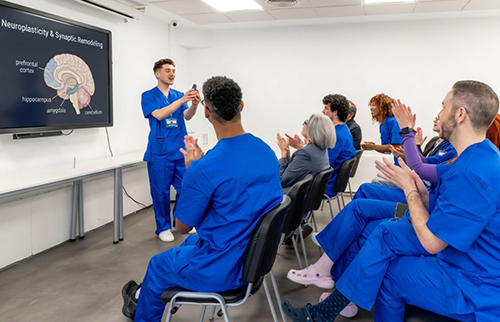
Professional development does not stop after earning a credential or finishing a degree program. Attending the AANN Neuroscience Nursing Annual Conference gives APPs fresh insight into leadership strategies used nationwide, and the conference has a track of sessions for APPs with advanced content.
Mentorship structures also strengthen this path, pairing early-career APPs with proven neuro-leadership role models. Mentor relationships often continue well past initial training programs into ongoing professional networks. Consequently, new leaders emerge with both technical skill and confidence in strategic decision-making.
Local chapters and special focus groups also provide additional support for nurses on this path. Getting involved early builds both skill and visibility within the broader neuroscience nursing community.
Growing Across Your Organization
Every neuroscience program can strengthen its leadership pipeline by investing in advanced practice providers early. Organizations that support ongoing education and mentorship see stronger neuro-leadership emerge from internal teams. Instead of searching externally for new hires, hospitals can grow the leaders they already employ.
Consider offering protected time for APPs to pursue certificate programs and attend conferences annually. Such investment pays off through improved retention, sharper clinical outcomes, and a stronger center of excellence overall.
Take the Next Step Toward Neuro-Leadership
Building a neuroscience center of excellence starts with recognizing the leaders already working within your organization. Strong neuro-leadership does not happen by accident, and it requires deliberate investment in people and process. Advanced practice providers who receive support today become the clinical leaders your program depends on tomorrow.
AANN remains committed to supporting neuroscience nurses at every stage of theirAANN remains committed to supporting neuroscience nurses at every stage of theirleadership journey. From certificate programs to conference education, resources existto help your team grow stronger together. We encourage program leaders andadvanced practice providers alike to reach out to AANN and start building that future today.
Categories: Professional Development | Advanced Practice | Neuro-APP Certificate